Last month, we looked at rates and pricing. Fast-forward a month, and rates are back down to where they were in Q3, so maybe the bulls were right? Time will tell.
This month, we'll look at a much less volatile but similarly relevant topic: Supply and Demand. Across the Inland Northwest, new apartment deliveries peaked in 2024, but construction hasn’t stopped. More apartments are being delivered, and the timing varies considerably by market.
There are reasons to be bearish and reasons to be bullish. Which side carries more weight depends on the market, the property, and your investment horizon. Let’s dig in!
Demand is relatively fluid, with fewer signals to track and more data variability, whereas supply can be tracked closely, since new apartments take time to permit, finance, and complete. Thus, current projects offer a useful view of the next two years. Dates can slip, but the pipeline is our closest thing to a crystal ball.
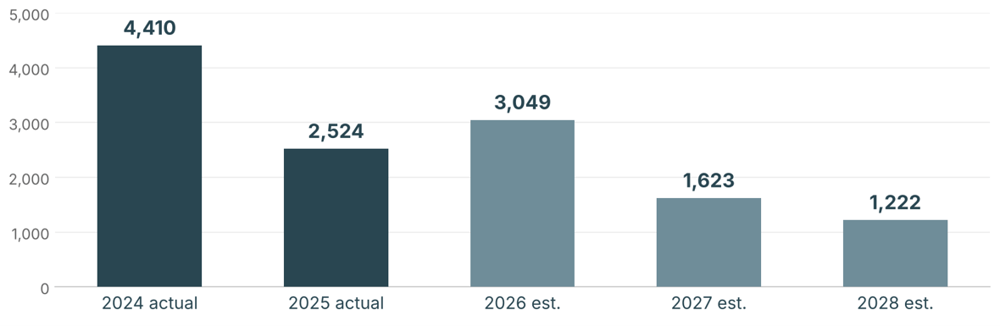
Across Spokane, North Idaho, the Tri-Cities, Wenatchee, and Walla Walla, approximately 4,400 apartments were delivered in 2024 and about 2,500 in 2025. Our current trackers suggest ~3,000 deliveries in 2026, ~1,600 in 2027, and ~1,200 in 2028.
Where those deliveries are being built is where the data gets interesting:
So, while supply will continue at moderated levels in the coming years, it really depends on the market. Ultimately, the same level of demand can produce very different outcomes in a market still absorbing new deliveries versus one where the pipeline is thinning.
The key test is on the demand side, which, as we mentioned, is harder to track, and really is what makes up the reasons to be bearish versus the reasons to be bullish.
In some markets, new supply may arrive faster than demand can absorb it. The market has delivered record supply over the last five to six years, and more is coming into a market where rents are flat to slightly down and concessions are up.
Spokane's 2026 is its second-largest delivery year after 2024. Wenatchee's 2027 is its largest in our data, which goes back to 2015. And the Tri-Cities, which has delivered ~1,100 units per year since 2024, still has 1,185 units in lease-up right now, with 650 more units coming next year.
Lease-ups are slow where supply is delivering right now. Spokane is running about 93% occupied overall, with several of this year's deliveries between 55% and 80% leased. The lack of supply coming next year positions the current deliveries for a strong lease-up, if demand continues.
Concessions start with new assets, then spread to older vintage buildings. Say a new two-bedroom unit rents at $1,850 with two months free. The effective rent is about $1,540.
A 1990s renovated property renting its two bedroom at $1,500 is now competing with it, so it drops to $1,350 or $1,400, or offers a month free, which is an effective $1,375.
Then the 1970s property in a different neighborhood has a hard time holding $1,300. That downward pressure takes time to make its way through the market, but it has a real effect on rents, and consequently, net income, cash flow, and the ability to refinance or exit a property.
Tenants have also learned to concession-hop. A one- or two-bedroom renter does not have much to move (a couch, bed, and personal effects), and many will move every year for a better offer.
Physical occupancy across the Inland Northwest sits squarely in the mid-90% range. However, our data shows that economic occupancy at some newer properties is in the low-to-mid-80% range after accounting for concessions. So, many buildings are full, but the income hasn't followed, and for some projects, 80% economic occupancy is underwater on its debt service, requiring cash infusions from ownership.
Demand may not outrun supply the way it did. From 2022-2025, demand beat supply even through big supply waves as rents and occupancy held steady. Looking ahead, there are fewer reasons to count on that. Renters feel the cash pinch and trade down the pricing ladder. Spokane County has about 1,400 fewer payroll jobs than a year ago, down 0.5%, and net migration into Washington fell by ~30% over the last year. And income is already soft this year while expenses keep rising.
Ultimately, this is the bear case, which many existing owners are seeing in their 2026 financials, or are seeing it on their 2027 budgets, requiring even more involvement just to maintain cash flow in the coming years.
This market has absorbed supply before. The previous wave of supply is at or near stabilization in every market. For most assets, outside of a rare exception, physical occupancy is in the mid-90s. Buildings delivered since 2022 sit about 1% lower than older properties, which is a normal lease-up curve, not distress. For example, Wenatchee absorbed about 620 units in 2023-2024 and that group is above 95% occupied today. The new supply delivered historically has not had the impact it could have had, or that many bearish investors were expecting.
Demand has always been here, and it is just less talked about. Again, this varies by market, but across the Inland Northwest, trends of positive migration to the region, job growth, and household growth have been the backbone of demand. This is evidenced by the data, broken down by market:
Franklin County (one of the Tri-Cities counties) was the fastest-growing county in Washington last year at +2.6%, and Benton County (the other of the Tri-Cities counties) ranked third, at +1.6%. Households run larger in the Tri-Cities, with 3.21 people per household in Franklin County and 2.70 in Benton County. Affordability helps drive this demand, considering the Tri-Cities cost of living index is 96 against a national 100, with housing at 85.7.
Spokane County added about 4,600 people, the fifth most in the state, and household size is 2.44. Many of those people coming to Spokane have been moving from the Seattle area for years. In the five years through 2019, ~1,200 more people moved from King County to Spokane County than the other way around. Spokane County's unemployment rate was 3.2% in September, a low reading for the year.
In central Washington, cheap hydropower has built one of the busiest data center corridors in the West, nearly 250 megawatts of capacity, with less than half a megawatt vacant, and the Tri-Cities is starting to follow, with Amazon announcing plans to acquire land that could support up to 16 data centers in the coming years.
This demand across migration, household size, affordability, and employment provides sustained and consistent demand across every asset vintage, not just new construction assets. This is the main case for quick absorption of the current supply wave, and even sustained rent growth in 2027 and beyond in many markets.
Demand only needs to overcome supply by market. Only about 300 units are scheduled for delivery in Spokane in 2027, against ~1,600 delivered this year. So in Spokane, demand does not have to do much to catch up to supply. In the Tri-Cities, the largest wave has passed and 2027 deliveries drop about 30% from 2026. In Wenatchee, where the biggest wave is still ahead, the bull case leans harder on demand.
The pipeline is thinning. A lot of projects started this year at a unique point in time when construction financing cost about the same as stabilized financing. We know developers who locked construction debt at 5.5% to 6%, fixed for five years, better than agencies were offering on stabilized deals. That window has closed. Construction capital costs more, is harder to find, and development costs keep rising. This puts pressure on developers and means fewer projects will put a shovel in the ground, leading to less new supply in the years to come. Owners who can weather a flat-rent year in 2027 are well positioned for rent growth as the construction pipeline contracts.
If you're bullish and looking to buy, choose the market, location, and product carefully. Know which new units will really compete for your tenants. Understand the employment, migration, and tenant-decision drivers of one property versus another. Underwrite concessions, lease-up, and realistic renewals, then consider how the supply picture may change over your hold period.
If you're bearish and considering a sale, pay attention to timing. Buyers will compare your rent roll with competing lease-ups and effective rents. You may want to get ahead of a local delivery wave, or hold through it while protecting consistent cash flow and building a clear operating story.
You get to choose how you see the future of investing in the Inland Northwest. If you’re bearish, maybe it’s time to get off the roller coaster ride. If you’re bullish, let’s roll up our sleeves and get to buying.
Reach out to our team and let us know which camp you’re in. Are you a bull, or are you a bear? And why?
One more thing before next month. We started the bulls-and-bears with interest rates, the highest-level metric and furthest outside your control. We zoomed into supply, which the broader market drives and you largely can't control. Next month, we zoom in further to review the lever you can actually control: operations and the property itself.
Receive monthly updates specific to multifamily investing in the Inland Northwest, curated for owners and investors