
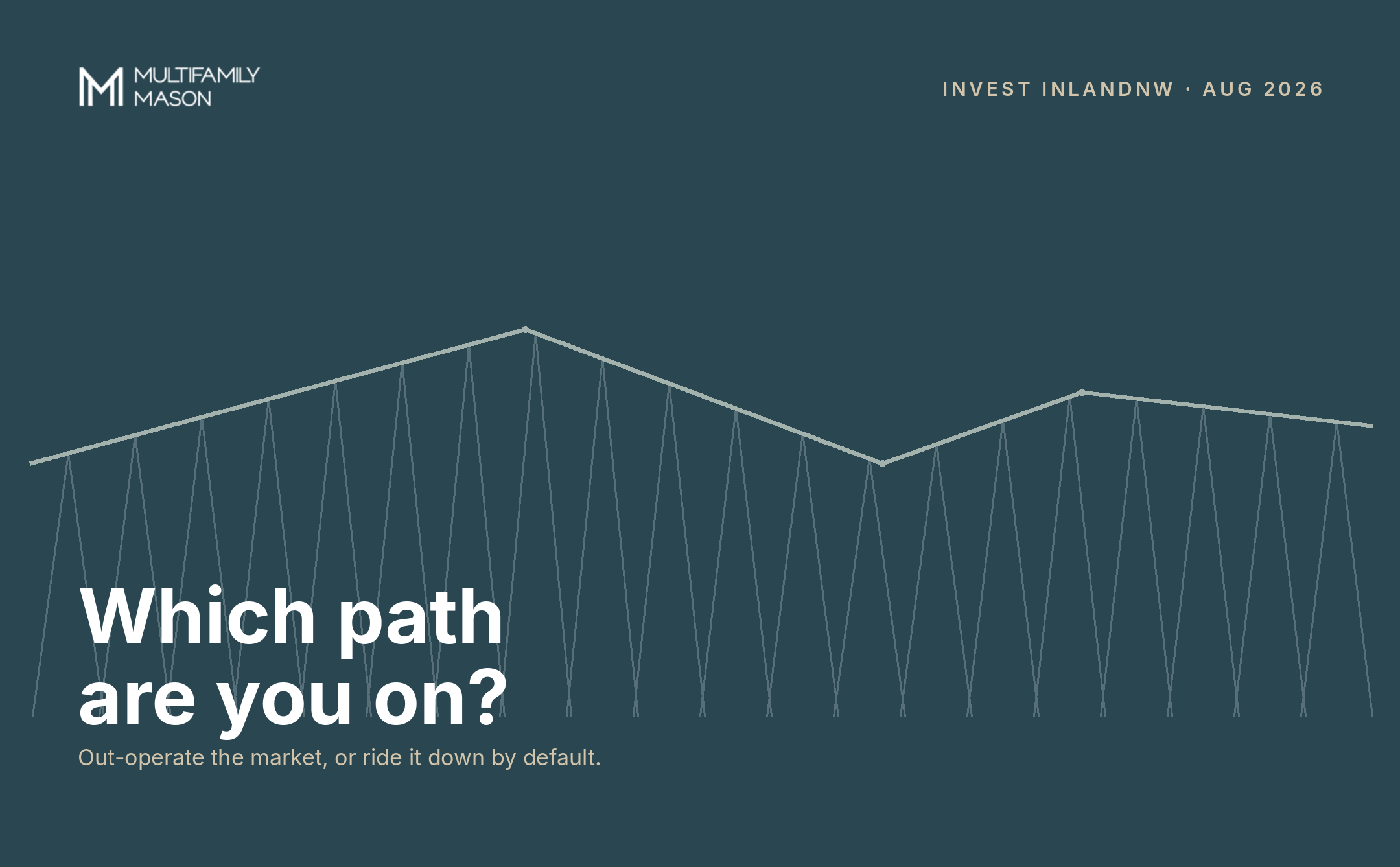
Multifamily owners have been on a six-year rollercoaster, and the market has now returned to a familiar formula: values and net operating income have recoupled. What your property earns once again drives what it is worth.
That leaves every property on one of two paths. You can actively out-operate the market, or you can let income, expenses, and capital needs pull performance lower by default. Neither path is decided by one big move — both are built from dozens of smaller decisions made, delayed, or overlooked each month.
We take a deep dive into each path in this edition of Invest InlandNW.
Last month, we reviewed the rollercoaster ride multifamily has been on for the last six years. Values and operations decoupled at the peak as buyers paid for projected income, then recoupled as interest rates, capital flows, and operations all normalized post-peak.
Today, buyers and lenders are underwriting real, in-place income again — making every $1 of NOI worth roughly $16 in value and $12 in refinance proceeds.
Today's market conditions, combined with the recoupling of NOI and values, present a fork in the road:
The difference between these two paths comes from the accumulation of small decisions made over time, across the following levers:
Ultimately, what matters is the end result of how these levers move and accumulate — either moving with the market, or beating the market.
This is where many of the properties we review sit today. And while no owners are actively choosing declines, it's simply what happens when a property runs on autopilot in a softening market. Let's dive into each lever of asset-level operations and unpack what declines look like.
Overall, online advertising is stagnant or nonexistent.
In addition, leasing is reactive.
When vacancy rises, traffic goals and marketing activity do not change. There is little urgency to pre-lease or adjust the campaign, and a less-than-ideal application may eventually be accepted simply to fill the unit.
Downstream of traffic, when a vacancy comes up, the team remains reactive.
In addition, new supply in the market is offering concessions, attracting your residents — or at a minimum your otherwise-qualified traffic — to shop elsewhere.
Later on, if a less-than-ideal tenant is accepted:
Ancillary income like parking, utilities, internet, and pet fees goes uncaptured. Ultimately, base rents may not change, but actual collected income slowly declines across some or all of these metrics.
And just like that, nearly every expense line moves the wrong way just as income softens.
On an aging asset, deferred maintenance becomes urgent at the least opportune time. Water heaters, appliances, flooring, HVAC, and the roof all move toward the front of the line at the same time — or just as you hit a patch of vacancy.
Here's a real-life example of how this snowballs:
This now becomes a capital and workload issue, putting stress on the leasing and maintenance teams when not proactively planned for — ultimately leading to higher expenses and more vacancy. And worst of all, the capital is being spent just to hold NOI flat, not to grow it.
A good property manager keeps the property running, and most do that well. But their job is to keep it full and functioning, not to gain every dollar of NOI. Without clear direction on where to push, the natural default is to keep things steady:
Each one is reasonable on its own, but together, over a year or two, they add up. The gap is not effort or talent; it's that no one is setting the priorities that turn good management into creating asset value.
And that is Decline by Default. It might sound bleak, but nothing dramatic happened here. There was no major patch of vacancy, competition, or major issue at the property.
On a mid-size property, NOI could fall from $200k to $150k over the course of a year. Because values are recoupled to NOI, that $50k decline equates to roughly $800k in value and $600k in refinance proceeds at today's multiples. And that is exactly the problem with today's market: if you're operating at status quo, value is eroding.
Obviously, you don't want this to be you and your asset — and it's not the only option. So what is the alternative?
Out-operating does not mean a full-scale change, adding amenities, or renovating a property to its studs to compete with new-construction assets. It means making your asset perform as well as it reasonably can under any market conditions. You want to beat the market — and it's possible, in any market.
Here are the same levers outlined above, but showcasing improving performance, not declining.
Active owners watch the traffic funnel (leads, tours, applications, leases) weekly.
Active owners do not wait for month-end to find a problem. The pipeline outlined above is a leading indicator of where the month will end.
Ultimately, the goal is not an unrealistic rent or even to increase base rents in today's market. The goal is to reduce vacancy, close loss-to-lease gaps, improve collections, and generate the income the property is already positioned to earn.
Across every line item, you can find improvements both upstream and downstream of each expense.
Operators build out a proactive plan before the need to be reactive ever comes up. With a proactive approach, we sort capital projects into three groups:
Across capital projects, be selective.
Ultimately, with a strategic plan, you can tackle deferred items before several hit at once, keeping the asset and operations in balance across each lever.
A capable manager can execute on the plan from ownership and does not need to be micromanaged — but you have to provide and reiterate the plan. For example:
For some properties that means weekly engagement; for others, monthly. The purpose is to make sure the team is not left setting the investment strategy while also handling the day-to-day.
Again, nothing dramatic happens. Cash flow simply moves in the right direction and compounds over time. If NOI grows from $200k to $225k, the additional $25k can support ~$400k in value and ~$300k in refinance proceeds.
When we contrast the two paths in practice, with a baseline NOI of $200k:
That is a $75k spread — and at today's multiples, the difference between Decline by Default and Out-Operate the Market is a staggering $1.2M in property value and $900k in refinance proceeds.
So when we talk to owners and they say, “Things are going fine,” our answer is simple: our job is to make sure “fine” isn't quietly costing you millions.
The market affects every property in the Inland Northwest, but you get to choose how the asset responds. You might decide it's time to roll up your sleeves, get to work, and out-operate the market. Or all the work described above sounds daunting and not what you signed up for. Either way, our role is to help you avoid the decline-by-default path.
That's what our Rollercoaster Review does: it takes a deep dive into which path your property is on and builds a roadmap for what's next, tailored to your assets and investing goals. Reach out to our team to get started with your Rollercoaster Review.
And one more thing before next month. If neither path fits what you want from the property, here is what most owners miss: you are not stuck on this rollercoaster ride. There is a third path, and it starts with a simple question — is the equity tied up in this property actually earning its best return where it sits today? That's what we'll review in our next edition of Invest InlandNW, coming early September.
Receive monthly updates specific to multifamily investing in the Inland Northwest, curated for owners and investors





-18.jpeg)


.jpg)
.jpg)
.jpg)